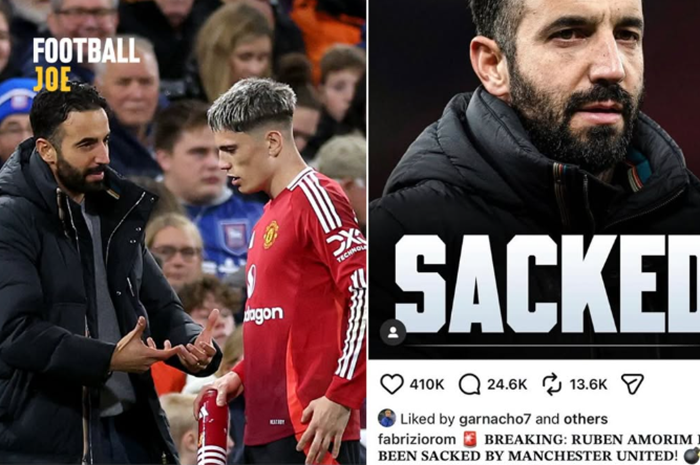
RADAR KUDUS - Ruben Amorim’s dismissal from Manchester United had barely settled into history when a single, almost invisible action reignited debate.
Alejandro Garnacho—once seen as the face of United’s next generation and now wearing Chelsea blue—quietly liked Fabrizio Romano’s Instagram post announcing Amorim’s sacking.
No caption.
No public statement.
No follow-up.
Just a tap on a screen.
In modern football, that can be louder than a press conference.
For casual fans, it may look meaningless. But for those who followed Manchester United’s turbulent last 14 months, Garnacho’s reaction felt deliberate—an emotional release compressed into a single digital gesture.
Baca Juga: Alejandro Garnacho Like Unggahan Fabrizio Romano Tentang Ruben Amorim Dipecat Manchester United
When Digital Body Language Replaces Words
Footballers today are acutely aware of how every online movement is scrutinized. A “like” is no longer passive engagement; it is digital body language—a subtle signal that can hint at relief, agreement, or unresolved frustration.
Garnacho’s response arrived instantly after Romano’s post went live. The timing mattered. So did the silence that followed.
In a sport where players are trained to avoid controversy, choosing to engage—however quietly—with news of a former manager’s dismissal rarely happens by accident.
For many observers, the message was unmistakable: this was personal.
Baca Juga: Perbandingan Statistik Amorim dan Maresca yang Sama-Sama Dipecat di Manchester United dan Chelsea
A Relationship That Never Fully Worked
The tension between Garnacho and Amorim did not emerge overnight. When the Portuguese coach arrived at Old Trafford, expectations were high. His tactical reputation promised discipline, structure, and clarity.
What followed instead was a gradual erosion of Garnacho’s role.
Under previous managers, the Argentine winger symbolized hope—raw pace, fearless dribbling, and a willingness to take responsibility in decisive moments. Under Amorim, that identity faded.
Minutes became inconsistent. Trust felt conditional. At key moments, Garnacho found himself sidelined while more conservative options were preferred.
For a young player whose game thrives on confidence, the message was clear: you are no longer central to the project.
Baca Juga: Darren Fletcher Ditunjuk jadi Pelatih Sementara Setelah Manchester United Pecat Amorim
From Prospect to Peripheral Figure
Amorim’s system demanded positional rigidity and tactical obedience. Garnacho, instinctive by nature, struggled to fit neatly into that structure.
While the club never framed it as conflict, the pattern was visible. Squad omissions. Reduced influence. Moments when Garnacho watched critical matches from the bench.
By the time summer arrived, the outcome felt inevitable.
His move to Chelsea in August was officially labeled a strategic decision. Privately, many insiders believed it was the culmination of a strained relationship rather than a purely footballing choice.
The talent did not disappear. The environment did.
Why the “Like” Matters More Than a Statement
Had Garnacho posted a comment, the backlash would have been instant. Headlines would accuse him of disrespect. Club narratives would tighten.
By liking Romano’s post, he avoided controversy while still expressing something deeply human: closure.
In elite football, players rarely get to explain their side. Contracts end. Managers leave. Stories remain untold.
That single interaction suggested satisfaction—not celebration, but relief. A sense that a difficult chapter had finally closed.
A Mirror of Manchester United’s Dressing Room Issues
Garnacho’s reaction also reopened uncomfortable questions about Amorim’s tenure at United.
His dismissal was not solely about results. Sources close to the club have long pointed to communication breakdowns, unclear role definitions, and growing frustration among younger players.
Several squad members reportedly felt marginalized. Others struggled to understand shifting tactical demands.
Garnacho became the most visible example of that disconnect.
When a former player reacts—even subtly—to a manager’s downfall, it hints at deeper structural problems that go beyond formations and match statistics.
Baca Juga: Bukan Karena Hasil Buruk, Ini Alasan Manchester United Mengakhiri Kontrak Ruben Amorim
Football’s New Reality: Reactions Live Forever
In previous eras, moments like this would fade. Today, they are archived, screenshotted, and dissected endlessly.
That single “like” now exists permanently in the public imagination, symbolizing a fractured relationship and a club still wrestling with its identity.
Amorim has left Old Trafford, but the consequences of his decisions remain part of the narrative.
And Garnacho, intentionally or not, reminded everyone that players remember more than clubs often realize.
Baca Juga: Manchester United Bayar Mahal Kompensasi Pemecatan Amorim
Two Careers, Two Diverging Paths
While Amorim reflects on a difficult chapter at one of the world’s biggest clubs, Garnacho has already moved on.
At Chelsea, he represents renewal—another chance to prove that talent sidelined is still talent untapped.
The contrast is striking. One man exits under pressure. The other quietly acknowledges it, then looks forward.
The “like” changed nothing materially. But symbolically, it captured everything.
Football is no longer played only on the pitch. It unfolds in timelines, notifications, and subtle online gestures.
Alejandro Garnacho did not speak. He did not need to.
With one silent click, he told a story of lost trust, unresolved tension, and personal relief—proof that in modern football, silence often says the most.
Amorim is gone from Manchester United.
But on Instagram, the echoes remain.